When Kitchen Chaos Creates Communication Champions: The Overcooked Series for Game-Based Learning
- Justin Matheson
- Jun 2, 2025
- 5 min read

Updated: Aug 20, 2025
You're a chef. A sushi chef. Your kitchen is a pirate ship that flies. All your countertops move if it's too windy. Your teammate is a shark that just lit a pot of rice on fire. Also, you're a dinosaur. Welcome to Overcooked!
"Wait, what?" is the most common reaction I hear when introducing Overcooked to clients. This chaotic kitchen simulator looks like pure cartoon mayhem—and it absolutely is. But beneath the flying food and frantic preparation lies perhaps one of the most authentic communication training tools I've ever used in game-based learning.
I've watched executive teams who can navigate high-stakes board meetings crumble when faced with the simple task of making virtual burgers. Why? Because Overcooked strips away corporate hierarchy and forces players to build communication systems from scratch—all while the kitchen is literally falling apart.
If you're looking for a game that creates genuine, low-stakes communication pressure, the Overcooked series delivers a master class in teamwork disguised as delicious fun.
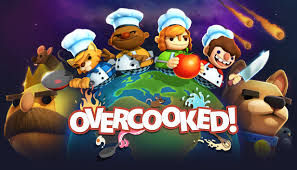
Game Overview
Developed by Ghost Town Games and published by Tea
m17, Overcooked burst onto the scene in 2016 for PC, PlayStation 4, Xbox One, and later Nintendo Switch. Its massive success spawned Overcooked 2 in 2018 and the compilation package Overcooked: All You Can Eat in 2020, which includes both games plus additional content in glorious 4K.
At its core, Overcooked is a cooking game. You control a chef (or chefs) working in increasingly bizarre and challenging kitchens. Players must chop ingredients, cook dishes, plate them correctly, and deliver orders within time limits to score points. Simple, right?
Not quite. Imagine trying to coordinate a kitchen while standing on two trucks driving side by side on a highway, occasionally separating and reconnecting. It's like trying to run a food truck inside a transformer that's actively transforming.
Learning Potential Breakdown: Overcooked Communication Training Benefits
Communication Under Pressure
Overcooked excels at creating authentic communication pressure without artificial stakes. When the kitchen is on fire (literally), and orders are piling up, players must quickly establish communication patterns that work.
The game forces teams to develop:
Clear, concise instructions: "Tomato, chopped, left counter!" becomes far more effective than "Can someone maybe help with getting that, um, I think we need some tomatoes over here..."
Closed-loop communication: Successful teams quickly adopt confirmation practices: "I need lettuce!" / "Getting lettuce now!" / "Lettuce delivered!"
Prioritization language: As orders build up, teams must communicate priorities: "Focus on the pasta first, it's about to burn!"
What makes this particularly valuable is that the game naturally creates communication urgency without artificial scenarios. The pressure comes from the gameplay itself—not role-playing or hypothetical situations.
Team Roles & Adaptability
Each Overcooked level requires different approaches to communication:
In split kitchens (where players are physically separated), teams must maximize information sharing despite limited visibility. Some teams develop incredible spatial awareness ("I'm putting the plate on the counter in 3...2...1...") while others create shorthand systems ("Code Red means we need tomatoes!").
The sequel, Overcooked 2, introduces the ability to throw ingredients, adding another layer of communication challenges. Teams must coordinate timing: "Ready to catch? Throwing onion in 3...2...1..."
Fail Forward & Feedback
Failure in Overcooked is an essential part of progress. There are levels where every successful strategy you've used so far will simply not work, and players will have to come up with new ideas and solutions.
The game's short rounds (typically 3-5 minutes) create perfect debrief opportunities. Teams can quickly identify communication breakdowns: "We never established who was calling out orders" or "We were all talking at once."
This rapid feedback loop—play, fail, discuss, adjust, replay—creates an accelerated learning environment that can accomplish in hours what might take weeks in traditional training.
In Practice: How I Would Use This Game for Training (Communication)
In a typical Rift workshop, I focus on a certain skill to teach or practice. For this example, let’s imagine working with a group (10-15 people) who is focused on communication skills. I'd set up 2-3 gaming stations with the Overcooked series loaded and ready. After brief introductions, I'd divide participants into teams of 3-4 players.
First, I'd have them play an early, straightforward level without any pre-discussion. This baseline experience usually results in chaotic communication and minimal coordination—the perfect "Aha!" moment is when they realize how challenging effective communication actually is.
After a guided debrief focusing on what worked and what didn't, I'd introduce a part of a simple communication framework: roles, priorities, or confirmation protocols. Teams would then play a more complex level, attempting to implement what they've learned.
The peak of the workshop experience comes when I introduce a level with unique challenges—perhaps the moving platforms of Overcooked 2's hot air balloon kitchen. Teams must now apply their communication skills to an environment that constantly changes, forcing them to adapt their systems on the fly.
To measure progress, I track three key communication metrics during gameplay:
Frequency of clear role assignments
Use of closed-loop communication
Response time to unexpected challenges
The beautiful thing? By the end of a 3-hour session, participants develop communication patterns they can immediately apply to workplace scenarios. They've experienced the difference between chaotic communication and structured systems—and they've had fun doing it.

Game-Based Learning Tips for Educators / Trainers
Implementation Strategies
Start simple, then complicate: Begin with the easier levels from the original Overcooked before advancing to the more chaotic scenarios in later games. This progression builds confidence before testing resilience.
Assign observers: For larger groups, rotate participants so some can observe and take notes on communication patterns. These outside perspectives provide valuable insights during debriefs.
Record gameplay: With permission, record both the gameplay and team communication. Reviewing specific moments during debrief helps participants recognize patterns they might have missed.
Accessibility Considerations
Accessibility note: Overcooked can be challenging for individuals with certain motor control issues. Consider pairing players so that one handles movement while another manages action inputs, creating natural communication requirements while accommodating different ability levels.
Wrap-Up
The magic of Overcooked isn't just that it's hilariously fun—it's that it creates authentic communication challenges that mirror workplace dynamics. When a team successfully coordinates to deliver a perfect pizza while their kitchen splits in half, they're not just playing a game—they're developing communication muscles that transfer directly to high-pressure workplace scenarios.
Research consistently shows that experiential game-based learning creates more lasting behavior change than traditional training methods. In Rift workshops, we often see dramatic improvements—imagine a team improving their communication efficiency by 40% between their first and final Overcooked sessions, then immediately applying those same patterns to their project coordination meetings.
The skills developed aren't theoretical—they're practical, tangible, and immediately applicable. And players learn them through experience rather than lecture, making the lessons stick.
Want to see more games that build essential workplace skills through game-based learning? Follow Rift's monthly game breakdowns for research-backed insights on using play for serious learning.
Interested in incorporating this type of learning or training in your work? Check out our current list of services.
JM


Comments